I Used Noise-Cancelling Headphones for 30 Days—Here’s What Actually Matters
557 views
A good noise-cancelling headphone can make a noisy room disappear.
For about 20 minutes.
Then your ears get warm, the headband starts pressing on one spot, the Bluetooth connection jumps to the wrong device, and somebody asks you a question just as your transparency mode decides to amplify a chair scraping across the floor.
That was the more useful part of my 30-day experiment.
Instead of judging active noise cancellation (ANC) from a five-minute demo, I treated noise-cancelling headphones as everyday gear. Flights. Coffee shops. Video calls. Late-night editing. Air-conditioned rooms with a constant low hum. A few situations where I genuinely forgot I was wearing them—and a few where I very much didn't.
The takeaway surprised me: the best noise-cancelling headphones aren't necessarily the ones that create the deepest silence in a spec-sheet comparison.
Fit matters. Software matters. The noise you want to remove matters. Even the way your phone handles Bluetooth can matter more than an extra few decibels of cancellation.
For GadgetRadar readers, that's the distinction worth making. This isn't another "best ANC headphones" list. Think of it as the stuff you notice after the honeymoon period ends.
The first lesson: ANC isn't one thing
People often talk about noise cancellation as if headphones have a single on/off score.
They don't.
Active noise cancellation works by using microphones to capture external sound and generating an opposing signal that reduces what reaches your ears. It tends to be especially effective against predictable, low-frequency noise: aircraft engines, HVAC systems, buses, trains, and that irritating ventilation unit you can't switch off.
Speech is harder.
A nearby conversation changes constantly. Keyboard clicks are sharp. A baby crying is basically chaos from an ANC algorithm's perspective.
During the month, this became obvious fast. The headphones that made an airplane cabin feel dramatically calmer didn't necessarily erase two people talking three feet away. Sometimes the voices became softer but strangely more noticeable because the low-frequency background rumble had disappeared.
Don't buy ANC expecting a portable cone of silence. Buy it to reduce fatigue.
That's a much better test.
Sony's current WH-1000XM6 is a useful example of how sophisticated this category has become. Its official specifications list Adaptive NC Optimizer, Ambient Sound, multipoint support, Bluetooth 5.3, and support for SBC, AAC, LDAC, and LC3. Sony also rates it for up to 30 hours of music playback with noise cancelling enabled.
Those are meaningful features. None tells you whether the earcups will seal properly around your glasses.
And that leads to the next problem.
Your head shape can ruin a $400 headphone
I spent far more time adjusting fit than I expected.
Move the earcup slightly backward: better bass.
Slide the headband forward: less pressure.
Put on glasses: suddenly the low-end rumble becomes more noticeable.
That's because passive isolation still does a huge amount of work. ANC is only part of the system. If the ear pads don't create a decent acoustic seal, outside sound leaks in, especially at higher frequencies where active cancellation is less effective.
Hair can affect it. Thick glasses arms can affect it. Even an earcup sitting a few millimeters off-center can change the experience.
This is why comfort isn't a boring secondary specification. It's performance.
The 30-minute test is almost useless
Try headphones for five minutes and nearly everything feels comfortable.
Wear them through a two-hour film.
Different story.
The pressure that felt "secure" becomes annoying. Heat builds inside the cups. Your jaw moves while eating or talking. You take them off for a minute, then hesitate before putting them back on.
That hesitation matters.
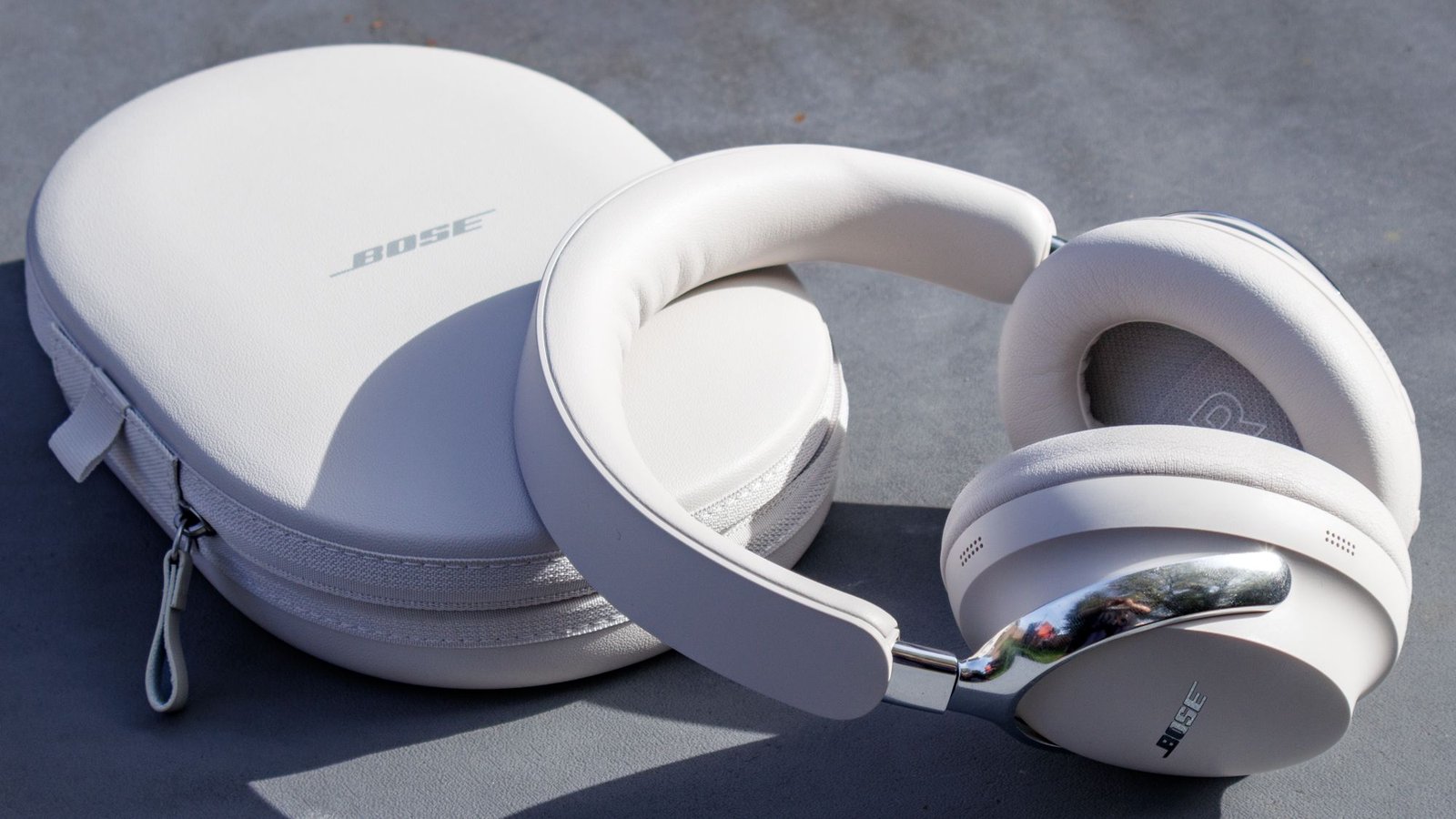
Bose still leans heavily into comfort for its QuietComfort line, and its current QuietComfort Ultra Headphones (2nd Gen) combine adjustable ANC, multiple listening modes, CustomTune personalization, Bluetooth 5.4, and a rated 30-hour battery life. Bose says Immersive Audio reduces that figure to up to 23 hours.
There's the kind of trade-off you'll actually notice after a week: turn on the more processor-intensive feature, and battery life changes.
Not a disaster. Just physics and product design.
Battery anxiety is mostly about charging behavior
I stopped obsessing over maximum battery ratings.
A claimed 30 hours is nice. So is 35. But in daily use, the better question is: what happens when I forget to charge these?
That's the real test.
A headphone with USB-C charging and reliable fast charging is easier to live with than one with a marginally larger battery but awkward power management. The QuietComfort Ultra Headphones (2nd Gen), for example, are rated by Bose for 30 hours in Quiet or Aware modes, while a 15-minute charge is rated for up to three hours of playback.
That sort of feature saved me more often than an extra theoretical five hours would have.
Sony rates the WH-1000XM6 at roughly 3.5 hours for a full charge. Again, fine—until you realize your departure gate changes, you've got 12% battery, and the cable is somewhere at the bottom of a backpack.
Tiny frictions. Repeated daily.
Those decide whether a product feels polished.
Bluetooth is where premium headphones can still act cheap
This was my biggest annoyance.
Multipoint sounds simple: connect the headphones to a laptop and phone simultaneously, then switch intelligently between them.
Reality is messier.
A laptop notification can interrupt music. A phone call may take priority when you didn't expect it. Some apps hold an audio connection longer than they should. Windows, macOS, Android, and iOS don't all behave identically, and Bluetooth profiles add another layer of weirdness.
I learned to check one setting before blaming the headphones: which device actually has the active audio session?
Sony's WH-1000XM6 also illustrates another modern complication. It supports both traditional Bluetooth audio and LE Audio, using LC3 for LE Audio. Sony explicitly notes that LE Audio prioritizes lower latency but can provide lower connection stability than Classic Audio in some situations; if audio stutters because of poor reception, Sony recommends reconnecting with Classic Audio.
That's useful because "newer protocol" doesn't automatically mean "better for every situation."
For gaming, low latency may be the priority.
For a crowded office with flaky wireless conditions? Stability wins.
Every time.
Codec support is nice. Compatibility is nicer.
LDAC sounds impressive. LC3 is newer. aptX Adaptive has its own advantages.
But the source device has to support the right path.
An iPhone user isn't automatically benefiting from LDAC just because the headphones support it. Android support varies by device and implementation. LE Audio requires compatible hardware and software on both sides.
Sony's documentation specifically requires a compatible Android device and the Sony | Sound Connect app for its LE Audio connection setup.
So before paying extra for a codec badge, check the boring part: what codec does your phone, tablet, laptop, or handheld actually use?
That answer is more valuable than the logo on the box.
Transparency mode became more important than I expected
The best ANC isn't always maximum ANC.
Sometimes I needed to hear an announcement. Sometimes I was waiting for a doorbell. Sometimes I just wanted to work without feeling completely disconnected from the room.
Poor transparency modes can sound metallic, compressed, or overly aggressive. The worst ones amplify sudden sounds so sharply that I immediately switched them off.
A natural transparency mode, by contrast, changes how often you'll use the headphones.
Apple's AirPods Max support switching between Active Noise Cancellation and Transparency, while newer AirPods Max models also offer Adaptive Audio that adjusts the balance between cancellation and outside sound as conditions change.
Bose takes a different approach with its current modes. QuietComfort Ultra (2nd Gen) offers Quiet, Aware, Immersion, and Cinema modes, while ActiveSense can reduce persistent loud sounds in Aware mode.
The implementation matters more than the marketing term.
After 30 days, I found myself judging headphones partly by how quickly I could move between isolation and awareness without digging through an app.
A physical button helps.
A reliable gesture helps.
A complicated mode menu does not.
The app is either invisible or irritating
No middle ground.
Headphone apps can be genuinely useful for:
Firmware updates
Custom EQ
Multipoint management
Noise-control adjustments
Button shortcuts
Device-specific connection settings
But I don't want to open an app every morning.
Sony's Sound Connect app is also relevant for configuring features such as LE Audio on supported devices, while Bose exposes EQ and customizable modes through its Bose app.
The best setup process happens once.
Then the app mostly disappears.
That wasn't always my experience. A firmware update prompt appearing right before leaving the house is annoying. So is discovering that a connection mode changed after an update and now the laptop behaves differently.
My rule became simple: update at home, not at an airport.
Sound quality matters—but only after the basics work
Here's the unpopular part.
I cared less about microscopic sound differences after using ANC headphones every day.
Not because audio quality stopped mattering. It absolutely does. But comfort, isolation, connection stability, and controls determine whether you'll actually spend enough time listening to appreciate the sound.
Once those basics are sorted, listen for three things:
Does the bass stay controlled when ANC is active?
Do vocals remain clear at low volume?
Can you listen for an hour without reaching for the EQ?
That third question is sneaky.
Some headphones impress immediately because they exaggerate bass or treble. Thirty days exposes the problem. A sound signature that feels exciting for one track can become tiring during an eight-hour workday.
I also stopped treating spatial and immersive processing as an automatic upgrade. Bose's Immersive Audio can create a wider, more externalized presentation, and its Cinema mode is designed around clearer dialogue and a movie-style spatial effect. Useful? Yes. Something I wanted enabled for every podcast and album? Not quite.
Sometimes regular stereo is exactly right.
What I'd check before buying
My buying checklist got shorter after the experiment.
Not more complicated.
What to check | Why it matters in real life |
|---|---|
Ear pad seal | A poor seal can undermine both bass and perceived noise reduction |
Comfort after 90+ minutes | Store demos rarely reveal pressure points or heat buildup |
Transparency quality | You'll probably use it more often than you think |
Multipoint behavior | Essential if you regularly switch between phone and computer |
Codec/device compatibility | LDAC, LC3, or other formats only help when your devices support the connection |
Battery with advanced modes enabled | Spatial or immersive processing can reduce runtime |
Physical controls | Faster than opening an app when you're moving around |
Wired audio options | Useful for flights, desks, gaming, and devices with Bluetooth limitations |
Notice what's missing.
A giant "ANC score."
That number can still be useful, but it shouldn't make the buying decision by itself.
FAQ: What people usually ask after buying ANC headphones
Do noise-cancelling headphones block voices completely?
No. ANC is generally most effective against steady, low-frequency noise. Voices, keyboard clicks, and sudden sharp sounds are harder to eliminate. A strong physical seal helps with those frequencies.
Is it bad to use noise cancellation all day?
For most people, the practical issue is comfort and awareness rather than the ANC technology itself. If you feel pressure, fatigue, or disorientation, take the headphones off for a while and avoid using maximum isolation when you need to remain alert to your surroundings.
Does higher Bluetooth version mean better sound?
Not automatically. Bluetooth 5.4 versus 5.3, for example, doesn't guarantee better audio quality by itself. Codec support, source-device compatibility, signal conditions, and the headphone's implementation all matter.
Is multipoint worth paying extra for?
If you use both a computer and phone every day, absolutely. If you mainly listen from one device, it may not justify a higher price. The quality of the switching implementation matters more than simply having "multipoint" printed on the feature list.
Should I leave immersive or spatial audio turned on?
Try it with movies and certain music first. Features like Bose Immersive Audio can consume more battery, and the processing isn't necessarily preferable for every type of content.
After 30 days, I'd spend differently
If I were buying another pair tomorrow, I wouldn't start by asking which model has the strongest noise cancellation.
I'd start with the places where I actually get annoyed.
Is it a two-hour flight with constant engine rumble? ANC becomes the priority.
Is it an eight-hour workday switching between a Windows laptop and an Android phone? Multipoint, microphone quality, comfort, and stable Bluetooth move up the list.
Is it a noisy commute followed by calls, music, and a movie? Then transparency mode, controls, battery behavior, and wired flexibility deserve a closer look.
That's the trick.
Don't shop for the quietest headphones in a vacuum. Shop for the pair that creates the least friction in your actual routine.
Spend a little longer testing the fit. Check which codecs your devices really support. Turn on every feature you'll use—not just the demo mode. Then imagine day 23, when the novelty has vanished and you're rushing out the door.
That's when you'll find out what actually matters.
noise-cancelling headphones
headphone review
focus and productivity
travel headphones
audio gear review
Found this helpful? Share it!