
Nothing Headphone (1) Review: Sound Quality, Design & Value
590 views
The annoying thing about premium headphones is that they often make you choose your compromise before you even press play. Want striking design? Expect average sound. Want serious audio tuning? Prepare for another anonymous black-and-silver plastic shell. Want strong ANC? Hope the companion app doesn't become a second job.
Nothing's first over-ear headphones try to dodge that trap.
The Nothing Headphone (1) launched at $299 and arrived with an unusually ambitious spec sheet: custom 40mm drivers developed with KEF, adaptive ANC rated up to 42dB, LDAC, USB-C audio, a 3.5mm input, Bluetooth 5.3, IP52 protection, and battery claims stretching to 80 hours with ANC disabled. Nothing's current US store even lists the headphones at $219, which changes the value equation considerably.
That sounds excellent on paper.
The reality is more interesting.
Headphone (1) gets a remarkable amount right, particularly its physical controls, battery life and willingness to look completely unlike every Sony, Bose and Sennheiser model sitting beside it. Sound quality, though, is the complication. Several established reviewers have landed in roughly the same place: the hardware is strong, the feature set is generous, but the default tuning can feel darker, less lively or less refined than the price suggests.
For GadgetRadar readers, that makes this less of a simple “buy” or “skip” product and more of a proper enthusiast gadget. You get better results if you're willing to open the Nothing X app and experiment.
And, frankly, you should.
The design is the whole point—and somehow it works
Nothing could have played this safely. It didn't.
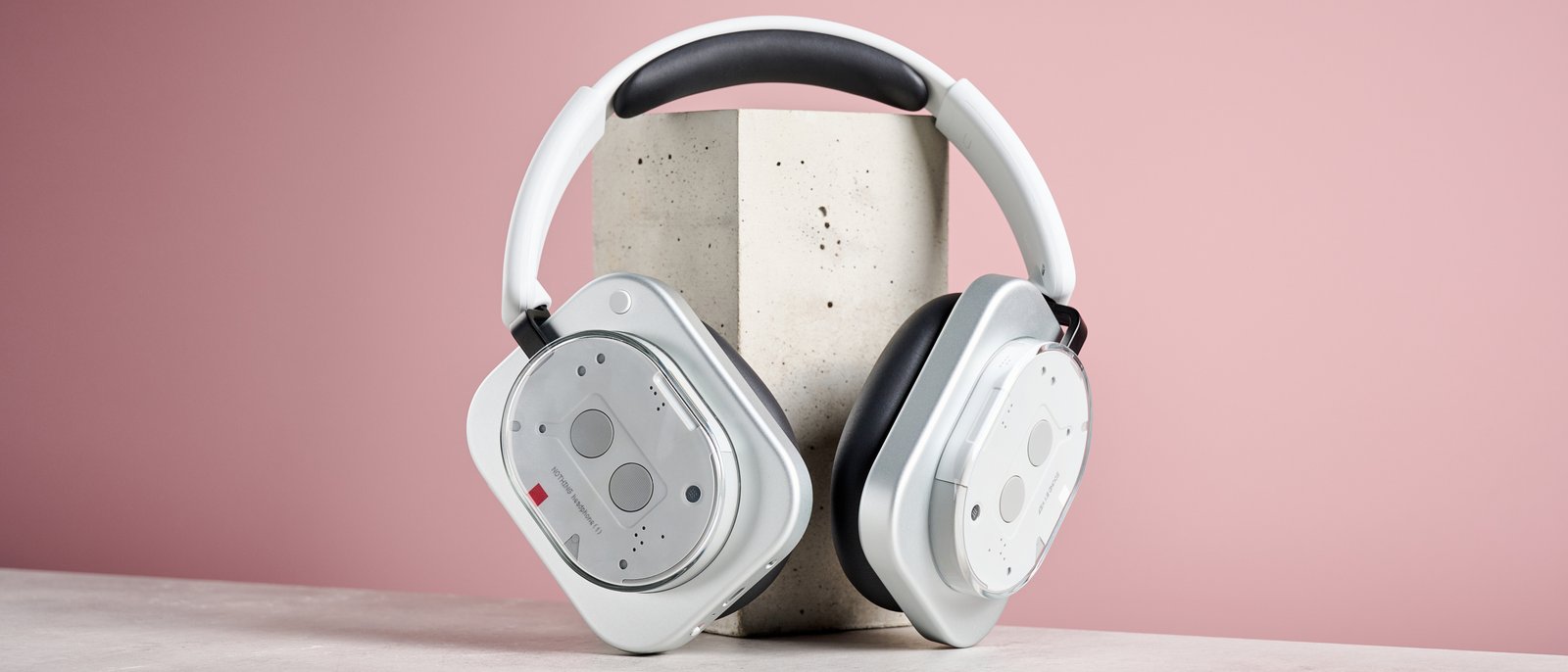
Headphone (1) looks like a collision between retro consumer electronics and modern industrial design: rounded transparent panels, exposed-looking visual details, aluminum elements and a shape that makes even expensive competitors look a little anonymous.
At 329g, these aren't featherweight headphones. The dimensions are roughly 174 × 78 × 189mm, and the earcups do not fold inward for compact travel. That last detail matters more than it initially seems. Toss a folding pair of Sony headphones into a backpack and they disappear. Headphone (1) takes up space.
Still, the design has a practical side.
The controls are excellent.
Instead of relying entirely on touch gestures—which can be infuriating when you're trying to skip a track with gloves on or after a slightly missed tap—Nothing uses distinct physical controls. The roller handles volume, play/pause and noise-control switching, while additional controls manage other functions. The shapes feel different enough that you don't need to remove the headphones to remember what you're touching.
That sounds minor. It isn't.
After spending years with capacitive headphone controls that occasionally interpret “adjust volume” as “launch voice assistant,” a mechanical roller is wonderfully boring. It just works.
Comfort: good, but not invisible
The memory-foam ear cushions provide a decent seal, and most reviewers consider the headphones comfortable for ordinary sessions. Long-haul listening is less universally successful. The 329g weight and relatively thin headband padding can become noticeable after extended use, especially if you're used to lighter models.
That's the friction here. Headphone (1) feels substantial, which helps it feel like a $299 product, but substantial is not always synonymous with comfortable.
Sound quality: capable hardware, imperfect first impression
The technical foundation is solid.
Nothing and KEF developed a custom 40mm dynamic driver with a 16-ohm impedance and a stated 20Hz–40kHz frequency range. Wireless playback supports SBC, AAC and Sony's LDAC codec, while wired listening is available through both USB-C audio and a 3.5mm connection. The headphones also carry Hi-Res Wireless certification and support audio specifications up to 24-bit/96kHz in supported configurations.
Yet the default sound is where the review becomes messy.
Bass has weight. Vocals are generally clear. Detail retrieval is respectable, and dense recordings don't immediately collapse into a fuzzy wall of sound. What Hi-Fi? found the presentation full-bodied and detailed, while other reviewers praised its clarity and low-end punch.
But there is a catch.
The stock tuning can sound dark.
SoundGuys specifically found that the headphones benefit from EQ adjustment, and TechRadar's testing similarly praised the feature set while criticizing the presentation for lacking the openness and dynamic excitement expected at this price. Tom's Guide reached a comparable conclusion: good hardware, but sound that requires more user intervention than it should.
That's frustrating because Nothing actually gives you the tools to fix much of it.
Don't skip the Nothing X app
This is the setup step many buyers will overlook.
Nothing X offers four standard sound profiles—Balanced, More Bass, More Treble and Voice—along with Custom and Advanced modes for deeper tuning. The app also controls features such as dual-device connection, wear detection and other headphone settings. Some features are disabled by default, so simply pairing the headphones and walking away leaves performance on the table.
A sensible first setup looks like this:
Update the headphones and Nothing X app before judging sound quality.
Enable dual connection if you regularly switch between a laptop and phone.
Try the More Treble profile or Advanced EQ if the default presentation feels closed-in.
Don't expect a miracle. EQ can't turn Headphone (1) into an entirely different acoustic design. It can, however, make the tuning feel significantly more suited to your music.
That distinction matters.
If you want a headphone that sounds perfect without touching a setting, some rivals remain easier recommendations. If you enjoy tweaking gear—adjusting an EQ, changing codecs or experimenting with ANC modes—Nothing's flexibility becomes part of the appeal.
ANC is strong, not class-leading
Nothing rates the adaptive active noise cancellation system at up to 42dB, with the headphones automatically adjusting noise reduction according to the surrounding environment. That's a theoretical maximum rather than a promise that every sound around you will disappear.
Real-world testing broadly supports that distinction.
Low-frequency noise is handled well. Aircraft rumble, air-conditioning drones and the mechanical wash of public transport become much less intrusive. Voices and sharper, unpredictable sounds are harder to eliminate completely, and the very best Bose and Sony models still have an edge.
The Guardian also noted that ANC can slightly narrow or mute the presentation on more complex music compared with listening without it.
So here's the practical verdict: ANC is absolutely useful for commuting, flights and noisy offices. Don't buy Headphone (1) expecting the market's most aggressive silence.
Battery life is one of the easiest wins
Battery anxiety is not a problem here.
Nothing quotes up to 80 hours of AAC playback with ANC off and up to 35 hours with ANC enabled. Switch to LDAC and the official figures drop to 54 hours without ANC or 30 hours with it, which is exactly the sort of codec-related trade-off worth knowing before comparing headline numbers. A five-minute charge is rated for up to five hours of playback.
Those figures are measured under controlled conditions, including 50% volume, so your mileage will vary.
Still, even allowing for louder listening and frequent ANC use, battery endurance is a genuine strength rather than a marketing footnote.
Connectivity is flexible, with a few quirks
Bluetooth 5.3 is the wireless backbone, with AAC, SBC and LDAC codec support. Headphone (1) also supports USB-C audio and 3.5mm wired input. That's unusually flexible in a market where manufacturers increasingly treat wired listening as an optional luxury.
Dual connection is supported too, but there's an important wrinkle: Nothing says the feature must be enabled through the Nothing X app. It's one of those small setup decisions that can produce unnecessary confusion when a user expects the headphones to automatically jump between a MacBook and an Android phone.
For Nothing Phone users, the ecosystem integration goes further, including brand-specific functions tied to Nothing's software ecosystem. Buyers using an iPhone, Samsung Galaxy or Google Pixel still get the core headphone experience, but some of the extra Nothing-specific features naturally have less relevance outside the company's own devices.
What about calls and durability?
The headphone uses a four-microphone system with AI-assisted voice processing, and Nothing says its Clear Voice Technology was trained using more than 28 million real-world scenarios. That sounds impressive, though independent testing has been less unanimous about microphone performance, particularly in busy environments.
For occasional calls, fine.
If you spend six hours a day moving between noisy cafés, train platforms and client calls, microphone quality should probably rank higher on your buying checklist.
Durability is more encouraging. The aluminum-and-plastic construction carries an IP52 rating for limited dust and water resistance—rare for over-ear ANC headphones—and Nothing says the product underwent more than 50 reliability tests covering drops, twisting, temperature and headband movement.
Don't wear them in a swimming pool. Obviously.
But a little rain or sweat is less terrifying than it is with many premium rivals.
Is the Nothing Headphone (1) good value?
At the original $299 price, the answer was complicated.
You were paying for distinctive industrial design, excellent physical controls, flexible wired and wireless connectivity, long battery life, adaptive ANC and a surprisingly deep software toolkit. Those are meaningful strengths. Yet competing headphones often delivered a more immediately satisfying sound or stronger noise cancellation.
At the currently listed $219 US price, the equation looks better.
The biggest competition is not necessarily another $299 flagship. It may be a discounted premium model or a strong mid-range pair that costs considerably less. TechRadar, for example, argued that the sound performance didn't fully match the feature set at the original asking price, while SoundGuys still rated the package positively for ANC, battery life, connectivity and software.
The lower the street price, the easier Headphone (1) is to recommend.
Nothing Headphone (1) FAQ
Is Nothing Headphone (1) worth buying?
Yes, especially if you value design, physical controls, battery life and extensive connectivity. Audiophiles who want perfect stock tuning without using EQ should audition alternatives first.
Does Nothing Headphone (1) support LDAC?
Yes. It supports LDAC, AAC and SBC over Bluetooth, alongside USB-C audio and 3.5mm wired playback.
How long does the battery last?
Nothing rates it for up to 80 hours with ANC off or 35 hours with ANC on using AAC. LDAC reduces the official estimate to 54 hours and 30 hours respectively.
Is the ANC as good as Sony or Bose?
It's effective, particularly against continuous low-frequency noise, but independent testing generally places the very best Sony and Bose models ahead for maximum noise isolation.
Can you connect two devices at once?
Yes. Dual connection is supported, but it needs to be enabled in the Nothing X app.
The final call
Nothing Headphone (1) is a surprisingly confident first attempt.
It isn't the automatic winner for pure sound quality. It isn't the quietest headphone on an airplane either. What it does offer is something many technically competent headphones have forgotten: personality.
Buy it for the design, the tactile controls, the marathon battery life and the flexibility of LDAC, USB-C and 3.5mm playback. Then spend ten minutes inside Nothing X. Try the EQ. Enable dual connection. Turn on the features that ship disabled.
That little bit of setup may be the difference between merely owning a strange-looking pair of headphones and finding a sound profile that makes them genuinely hard to take off.
Nothing Headphone (1) review
Nothing headphones sound quality
Nothing Headphone design
Nothing ANC headphones
Nothing Headphone value
Found this helpful? Share it!