
Meta Orion Glasses Review: Features, Real Use & Limitations
575 views
Pulling out a phone to answer a simple message, translate a sign, or capture a quick photo sounds trivial—until your hands are full, you're walking, or the moment has already disappeared.
That friction is the pitch behind Meta Orion.
Meta's experimental augmented-reality glasses are far more ambitious than the camera-and-speaker smart glasses most people have tried. Orion aims to put contextual digital information directly into your field of view while keeping the interaction model closer to ordinary eyewear than a bulky VR headset.
The catch? They're not a normal retail product. At least not yet.
For GadgetRadar readers, that distinction matters. Orion isn't something you can casually compare with the latest smartphone, add to a cart, and test for 30 days. It's a technology demonstration and a glimpse at where Meta wants personal computing to go next. The hardware is fascinating. The practical limitations are just as revealing.
What Meta Orion actually is
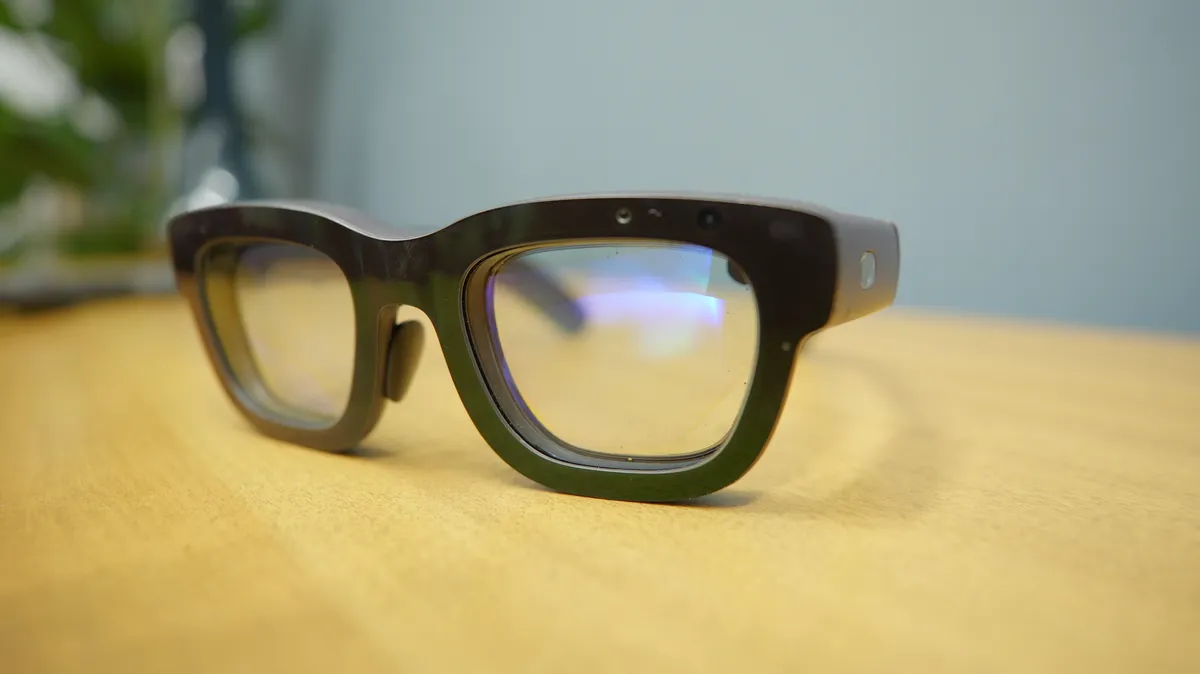
Meta unveiled Orion in 2024 as a prototype pair of true AR glasses. Unlike Meta's Ray-Ban smart glasses, which focus on cameras, open-ear audio and AI assistance, Orion includes transparent displays capable of placing digital graphics into the user's view.
That's the big leap.
The system combines several pieces of technology:
MicroLED projectors built into the frame
Silicon-carbide waveguides that direct light into the lenses
Eye tracking
Hand tracking
Voice input
A neural wristband using surface electromyography, or sEMG
Meta has also described Orion as having a roughly 70-degree field of view, dramatically wider than the tiny notification-style displays associated with earlier smart-glasses concepts.
The glasses work with a separate compute puck rather than putting every processor and battery component inside the frame. That decision sounds inelegant at first. In practice, it exposes one of the central engineering problems: advanced AR needs substantial processing, thermal management and battery capacity, while glasses need to remain light enough to wear on your face.
Physics is annoyingly stubborn.
The display technology is the real story
Orion's most interesting feature isn't the AI assistant. Plenty of products have one of those now.
It's the optical system.
AR glasses need to generate digital imagery, route that light through extremely thin optics, and overlay it convincingly on the physical world. Orion uses silicon-carbide waveguides, a material Meta selected for its optical properties, allowing the glasses to support a relatively wide field of view in a compact form factor.
That doesn't mean the experience is identical to looking at a physical object.
Current AR systems still face familiar compromises: brightness, display resolution, contrast, outdoor visibility, color accuracy and the unavoidable question of how convincing a virtual object looks when placed over a messy real-world background.
A bright interface in a controlled demo room is one thing. A navigation prompt on a sunny Malé afternoon, reflected against glass buildings and competing with tropical daylight, is another.
Those conditions are where futuristic concepts earn—or lose—their appeal.
A 70-degree field of view changes the interaction
Field of view matters because narrow AR displays can feel like looking through a small floating window.
Orion's approximately 70-degree field of view gives digital elements more room to exist naturally around the wearer. A virtual video call can occupy a meaningful portion of the scene. A floating browser window doesn't have to feel like a postage stamp hovering in front of your nose.
Still, 70 degrees is not the entire human field of vision. Peripheral awareness remains largely physical, which is probably a good thing for everyday use. You don't want a spreadsheet taking over your entire visual world while crossing a road.
The neural wristband could be more important than the glasses
Touchscreens trained us to interact by reaching for rectangles.
Orion points somewhere else.
Meta's input system includes a wrist-worn controller based on sEMG, a technique that detects electrical signals generated by muscle activity. The idea is to recognize subtle finger and hand movements before those movements need to become large, obvious gestures.
A small pinch might select an item. A different motion could scroll, navigate or trigger an action.
That's potentially a better fit for AR than waving your arms around.
Hand tracking alone can be impressive, but it also creates awkward real-world moments. Holding your arm in front of your face for several minutes gets tiring. Camera-based tracking can struggle when hands leave the sensors' view. And nobody wants to look as though they're directing invisible airport traffic just to skip a song.
The wristband approach reduces that problem.
It also introduces another one: users now have another device to charge, wear and remember.
Classic wearable-tech tax.
What using Orion could feel like
The most compelling Orion demos focus on small, immediate interactions rather than recreating an entire desktop computer in mid-air.
That restraint makes sense.
Imagine receiving a message while cooking. Instead of grabbing a phone with flour-covered fingers, a notification appears in your view. You glance at it, dictate a response, then dismiss it.
Or you're looking at an unfamiliar ingredient and ask the assistant for a recipe suggestion.
Navigation is another obvious use case. Directions can theoretically appear in context without repeatedly checking a smartphone screen. Translation could work similarly: look at text, request help, and receive an interpretation without the familiar sequence of unlock-phone-open-app-point-camera-wait.
Those are the moments where AR glasses make intuitive sense.
The danger arrives when developers try to turn the lenses into a floating monitor farm. Six virtual screens may look spectacular in a keynote demo. They can become visual clutter surprisingly fast.
Sometimes you just need directions.
Meta AI makes the concept more practical—and raises familiar questions
Meta has positioned AI as a major part of its wearable strategy, and Orion naturally extends that idea.
An AI system connected to cameras and contextual sensors can potentially understand more than a typed prompt. It may know what the wearer is looking at, what they just asked, and what information is already visible.
That multimodal interaction is useful.
Say you're repairing a gadget and can't identify a connector. A contextual AI assistant could examine the component and explain what it is. While traveling, it could identify landmarks or help interpret menus. During a video call, digital information could remain visible without forcing you to constantly look down at another screen.
But there are limits.
AI can still hallucinate. Computer vision can misidentify objects. Context may be incomplete. An assistant confidently giving the wrong repair instruction is more dangerous than a chatbot recommending the wrong movie.
Privacy also becomes harder to ignore when cameras, microphones, eye tracking and contextual AI live in a device designed to be worn in public.
Meta's existing smart-glasses products already use recording indicators, but Orion-style AR pushes the conversation further. People around the wearer may not know what sensors are active, what information is being processed, or whether an interaction is stored locally, transmitted to a cloud service, or used for AI processing.
That isn't a minor footnote. It may determine how acceptable the product becomes outside controlled demos.
The compute puck is clever, but it's also a limitation
Meta didn't put everything inside the glasses.
Instead, Orion relies on an external wireless compute puck. This helps reduce the weight and complexity of the frame, but it creates an obvious usability trade-off.
Now there are two things.
You need the glasses. You need the puck. Both need power. Both need to remain connected.
Forget your phone and you're inconvenienced. Forget the compute puck and your advanced AR glasses may become considerably less advanced.
There's also the battery question. Compact wearables already struggle with power consumption, and AR displays, cameras, sensors, wireless radios and AI workloads don't make that engineering problem easier.
Heat is another enemy. A warm smartphone can be annoying. A hot device resting directly on your face is much worse.
Meta Orion vs. Ray-Ban Meta: don't confuse the two
This comparison trips people up.
Ray-Ban Meta smart glasses are consumer products built around cameras, speakers, microphones and AI. They don't provide the full transparent AR display experience demonstrated by Orion.
Orion is the research-heavy moonshot.
That means a shopper considering smart glasses today should not treat Orion as a direct purchasing alternative. The more useful comparison is conceptual:
Feature | Meta Orion | Ray-Ban Meta |
|---|---|---|
Transparent AR display | Yes, prototype system | No |
Eye tracking | Yes | Not the same AR interaction model |
Neural wristband input | Yes | No |
Camera and AI capabilities | Yes | Yes |
External compute hardware | Yes, compute puck | Consumer-oriented standalone design |
General retail availability | No | Yes |
Orion shows where the category could go. Ray-Ban Meta shows what Meta can currently package for mainstream users.
That's a significant gap.
The biggest limitations nobody should ignore
It isn't a normal consumer product
This is the first limitation and the most important one.
Orion has been presented as a prototype rather than a mass-market product with standard retail pricing, carrier availability and a published long-term support schedule. Meta has discussed the enormous cost and engineering complexity involved in building the hardware, which helps explain why the company hasn't simply launched it as another consumer gadget.
The software ecosystem is still the unanswered question
Great hardware without useful applications doesn't stay great for long.
AR needs software designed around glances, short interactions and spatial awareness. Simply porting smartphone apps into floating windows won't be enough.
Developers will need to decide what information deserves visual space and, equally important, what should stay hidden.
That sounds simple. It isn't.
Style and comfort remain unresolved
A demo unit only needs to impress for a limited period.
A consumer device has to survive an entire day.
It needs to work with different face shapes, hairstyles, prescriptions and lighting conditions. The frame must avoid feeling front-heavy. The bridge can't become uncomfortable after an hour. Battery compromises can't turn the glasses into something people admire but rarely wear.
Wearables live or die on that boring stuff.
Who should pay attention to Orion?
Not people waiting for a checkout button.
At least, not yet.
Orion is worth watching if you're interested in spatial computing, AI interfaces, display engineering or the future of hands-free computing. Developers should also pay attention because the interaction patterns Meta is demonstrating—gaze, voice, subtle gestures and contextual AI—could influence future wearable platforms even if the final commercial hardware looks completely different.
For regular gadget buyers, patience is the smarter strategy.
The prototype proves that advanced AR glasses can move beyond science-fiction concept art. It does not prove that Meta has solved affordability, all-day battery life, privacy concerns, app availability or social acceptance.
Those problems are waiting in line.
FAQ: Meta Orion Glasses
Are Meta Orion glasses available to buy?
No. Orion has been presented as a prototype platform rather than a standard consumer retail product.
How are Orion glasses different from Ray-Ban Meta glasses?
Ray-Ban Meta glasses provide cameras, audio and AI features but don't include Orion's transparent AR display system, eye tracking and neural wristband interaction model.
Do Meta Orion glasses need a phone?
Orion's prototype architecture uses a separate wireless compute puck to handle processing rather than operating entirely as a self-contained pair of glasses.
What does the Meta Orion wristband do?
It uses surface electromyography (sEMG) to detect subtle electrical signals associated with muscle movements, allowing gesture-based control without relying entirely on large hand motions.
When could consumer Orion glasses launch?
Meta hasn't established a standard public retail launch for the Orion prototype. Any eventual consumer version could differ substantially in design, hardware, price and features.
Should you be excited?
Yes—but selectively.
Meta Orion is impressive because it tackles the hard part of smart glasses: making digital information visible in a wearable form without strapping a full headset to your face. The wide-field AR display, eye tracking and sEMG wrist input suggest a genuinely different way of interacting with technology.
Yet the prototype also exposes the unfinished business. External compute hardware, battery constraints, manufacturing costs, privacy concerns and an unproven everyday software model are not small obstacles.
For now, the best move is to watch what happens next. Pay attention to the consumer version Meta eventually builds, but don't judge it by keynote magic alone. Look for the boring details: battery life, weight, outdoor visibility, prescription support, repairability, software restrictions and what happens after the novelty wears off.
That's where the real review will begin.
Meta Orion Glasses review
Meta AR glasses
Orion smart glasses
Meta Orion features
Meta Orion limitations
Found this helpful? Share it!